
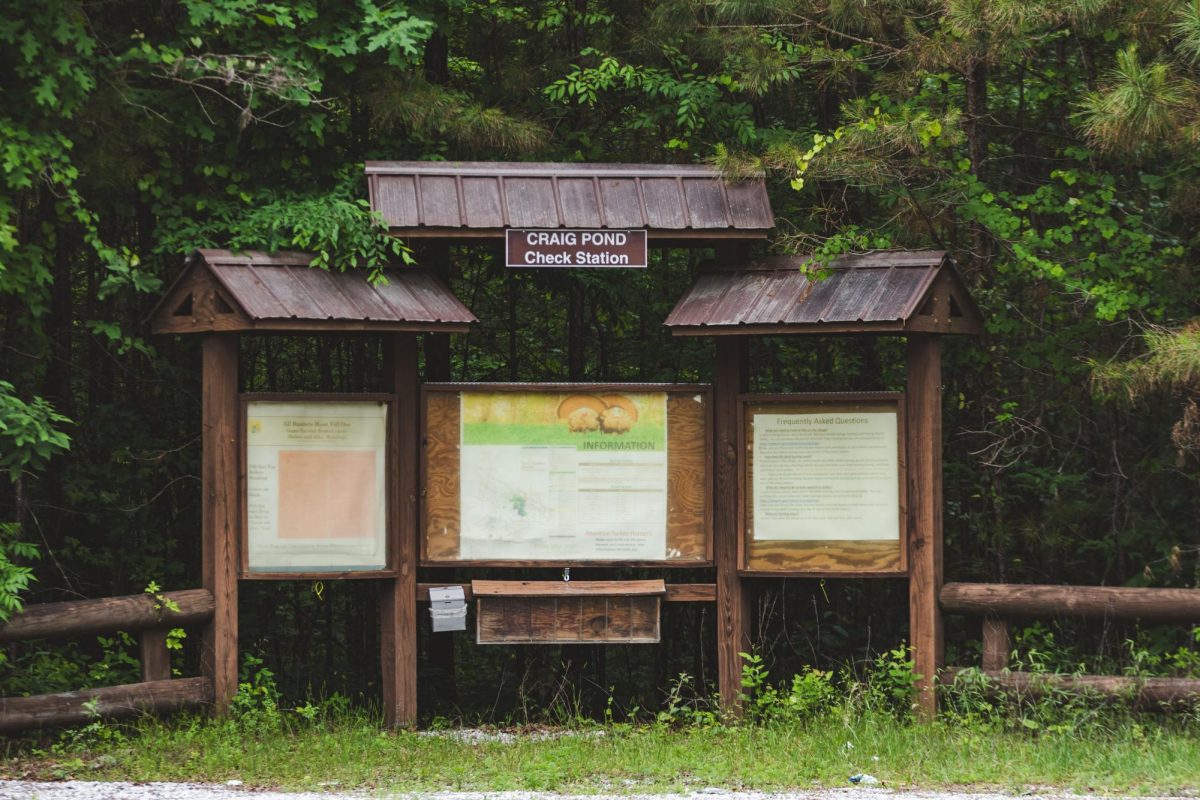
Water flows around a fallen tree, its trunk having rested in the creek for years. A bird chirps in the distance. Grass rustles as everything else dances in the gentle breeze. It is serene, calming and almost alarmingly different from the constant noise of Starkville.
When was the last time you went out and enjoyed nature in full? Not just going out on a drive through the country or watching the birds and squirrels on the drill field, but actually going out and enjoying nature away from all the noise of the city, walking a trail or hiking through the woods?
If you are anything like I was at the start of this semester, it has probably been a long while.
Lots of students spend their free time on campus, working on assignments, hanging out with friends or just generally living. Off campus, most students still spend their time in town, whether that means an evening at Dave’s Dark Horse Tavern for trivia night, dinner at Buffalo Wild Wings or just hanging out at a friend’s place. Occasionally, some folks might go for a drive, maybe to Columbus or West Point, or just pick a road and travel down it to enjoy the scenery.
But for most, going out hardly ever includes going hiking on a trail, unplugging or just spending hands-on time in nature.
I was the same until a couple of months ago, when a dear friend of mine told me they wanted to “show me something” as we got in their car. They told me it would be about 30 minutes until we got there and did not explain much else.
That something was the Sam D. Hamilton Noxubee National Wildlife Refuge, 12 miles south of Starkville, home to several trails and a couple of overlooks. We spent hours there, alternating between watching from an overlook and walking along one of the trails. The views were beautiful, but that was far from all.
The sound of nature alone was incredible. While often distant, wildlife can be heard from much farther away thanks to the lack of noise pollution.
That lack of noise pollution is good in its own right. Despite its near-universal prevalence in towns and cities, noise pollution has been linked to several adverse health effects, both mental and physical. According to the Center for Occupational and Environmental Health, these effects include an increased risk of cardiovascular disease and increased risks of anxiety and depression. Even if brief, a break from the constant noise can be a wonderful change of pace.
As I was appreciating this, my friend mentioned the woodpeckers that frequent the area, including the red-cockaded woodpecker, an endangered species. While I never saw any woodpeckers myself, I heard them and saw their markings on the trees I passed while walking the trails. I could not help but be in awe, as I have never come close to seeing any in person.
Despite the occasional chirps, caws and even rarer drumbeat of those woodpeckers, one particular thought kept crossing my mind: It is so, so quiet.
Even when it seems quiet on campus, there is an ever-present droning, a faint cacophony of sounds. Inside, the light fixtures buzz as electricity flows through them, and the air conditioners hum as they blow out cool air. Outside, those same air conditioner units emit even more noise, mixing with the sound of distant cars and buses. Sure, none of that is enough to be a conscious bother, but it is still noise pollution. Just quiet enough to get used to, just quiet enough to forget what true quiet sounds like.
Meanwhile, on the trail, instead of constant noise, it is just your steps against the dirt, the whistling wind and the occasional cry of a crow or chirp of a cardinal as you walk. It is uniquely peaceful, almost eerie.
Studies have shown that these kinds of trips into the woods are good for you, and not just mentally. According to the National Institutes of Medicine, simply spending time in nature can help reduce stress, improve sleep quality, lower blood pressure and boost one’s immune system. Plus, that is without mentioning the benefits of exercising and hiking in general.
These experiences are somewhat close to campus, too, and accessible with access to a car. Of course, there is the Noxubee Wildlife Refuge to the south, but to the southwest is the Tombigbee National Forest. Then, about 45 minutes west, there is Jeff Busby Park, home to one of the highest points in Mississippi, Little Mountain.
Even if you do not have a car of your own, a walk through Starkville still has plenty of its own benefits. While not the same as a hike on a trail or through the forest, according to Harvard Health Publishing, it is still beneficial for you to get in some physical activity.
Do remember that while walking alone is helpful, walking in nature has been shown to offer additional benefits. So even if it takes some extra time out of your day to get there, it is worth considering.
Even with the approaching summer heat, spending part of your morning or afternoon hiking is far from a bad idea. The tree cover ensures that the sun is not beating down on you, and the occasional light breeze makes a world of difference, even in the middle of the day. The most there is to worry about is just bringing some bug spray and water, which should already be a priority.
It can be easy to get caught up in the hustle and bustle of college life, but the occasional trip back into nature, even if brief, can make a world of difference.