As a culture, the United States has adhered to a strict business-oriented and results-driven society in which high performance and success are recognized, but the consequences of them on the human psyche are not.
This is true in everyday employment and student campus culture, where, according to Inside Higher Ed., over 90% of students say their mental health disrupts their ability to complete assignments or study. To add, four out of five college students report experiencing a varied level of burnout in their undergraduate careers, according to the American Society for Clinical Laboratory Science.
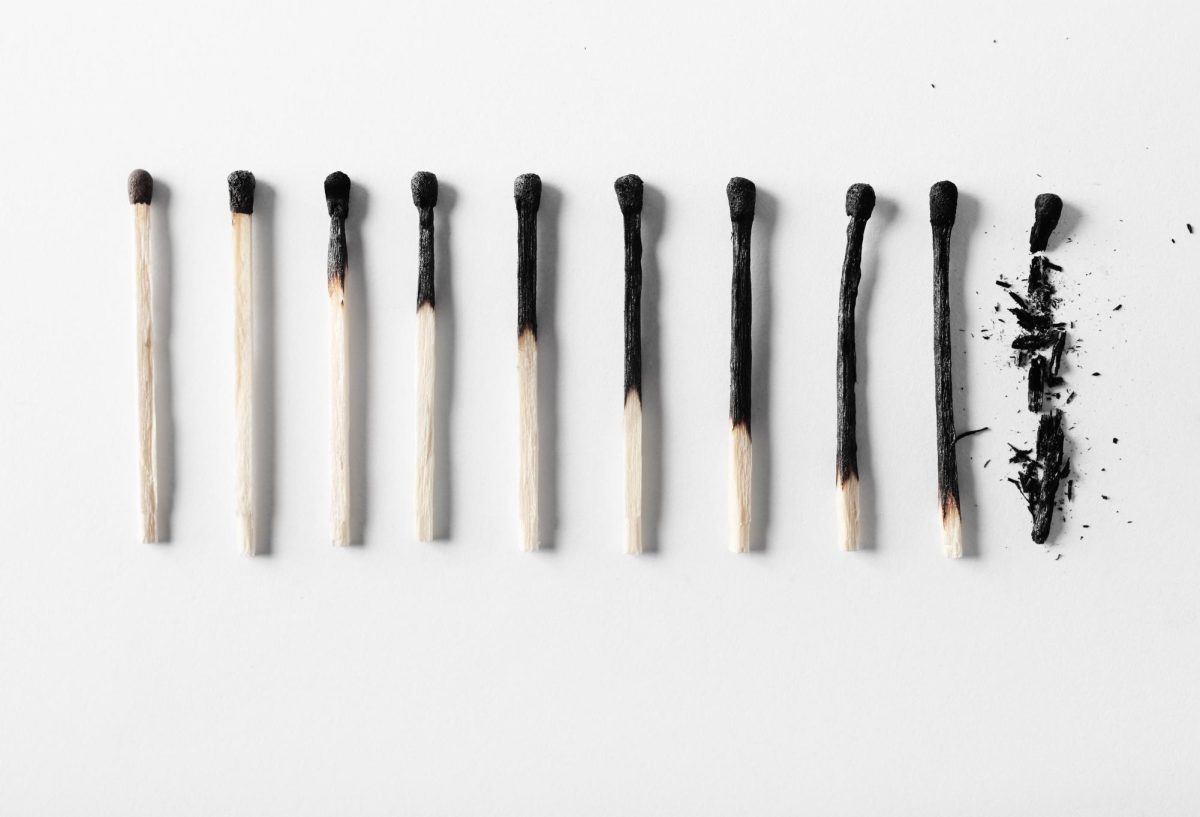
Burnout itself is an individual response to chronic stress, according to the National Library of Medicine. The term itself is synonymous with a lack of passion and drive and how the perennial stress of daily work causes exhaustion: mentally, physically and emotionally.
While it is up to individuals to rest, set boundaries and recover, today’s culture has turned burnout into a badge of success instead of deterioration. This mindset limits workplace mental health support and promotes a high-stakes academic environment.
A 2017 study done by the Journal of Consumer Research found that people perceive those who work longer hours and have less leisure time to be the most ambitious, important and admirable, according to Psychology Today.
More stress and less time for relaxation have a direct correlation with less effectiveness in everyday work and achievement. Burnout, caused by this stress and limited leisure time, contributes to the lack of efficient work activity. Burnout is a well-oiled gear in the wheel of constant anxiety and crisis.
Capable individuals cling to the burnout culture and way of living because, without it, they fear falling behind.
College students stressed by burnout tend to quietly disengage in ways institutions and campus counseling often miss. According to an article by Inside Higher Ed, while 92% of students report academic confidence, 31% stated that, when it comes to persistence, they considered transferring and 24% said they considered dropping out.
Institutions gather information and metrics on academic progress and use of campus resources for the student body. This creates a disconnect between the universities and the students they seek to uplift. According to Nicole Trevino, the Vice President at virtual health and well-being company Timelycare, these statistics tend to focus on primarily on the results of their services and not the actual well-being of the students. This gap is reflected in reports showing that many students are just doing alright. They are neither failing, nor thriving.
Some of the major stressors in early adulthood, according to the Harvard Graduate School of Education, are achievement, appearance, social life and future-planning. College students face constant pressure to succeed academically, plan their careers and maintain a strong social image, all of which contribute to rising levels of burnout. With these strenuous details of life taking precedence over mental health, burnout becomes almost inevitable.
Burnout is not treated as the warning sign it should be. Students adapt to their unstable conditions long before universities know how to respond, often pushing through burnout rather than addressing it head-on. Students often reach a breaking point before universities and their approved methods of mental-health care can take effect. Universities should more actively monitor these early behavioral signs and provide support accordingly, not with an assumption that their previous methods will always work.
Students develop a deep, internal fear of failure and it can be directed to a need to succeed. Not to learn the material and grow, but to pass.
About two in five students say they have skipped an exam at least once, according to Inside Higher Education. Half of them say it was because of a fear of being unprepared, a lack of motivation or because their stress had manifested itself in physical illness. According to the Mental Health Coalition, the demand for mental health counseling has grown five times as fast as the average student enrollment rate, yet only 25% of students with a mental health struggle seek help.
America puts more emphasis on success and achievement than on mental health and care for oneself, which, coincidentally, creates burnout and a lack of desire to achieve. Institutions must evolve their practices to get out of the restraints of solely developing counseling services and work to train faculty on noticing the signs of burnout in students and encourage them to find like-minded individuals to enhance their mental state, instead of accepting exhaustion.
Mississippi State’s 24/7 remote telehealth option and its counseling center offer services for these needs, but additional methods might be needed in other sections of campus. Integrating mental-health checkins into advising meetings, offering walk-in or single-session counseling that does not require a sign up or repeated future checkins, or even peer wellness support networks are advisable means of confronting burnout head-on, according to the American Psychological Association and the Massachusetts College of Pharmacy and Health. Specialized, skill-based workshops are encouraged as well, which can be found at Active Minds on campus as well. Occasional wellness check-ins for students may not be effective alone.