

Since the start of the 2025-2026 academic year, Mississippi State University has seen an increase in reported thefts of bicycles and electric scooters on campus.
Electric scooters have become increasingly common on college campuses in recent years. According to market research firm Precedent Research, the global electric scooter market surpassed $48 billion in 2025 and is projected to grow by about 20% over the next decade.
According to MSU Parking Services, there have been 1,101 scooter and bike permits sold for the 2025-2026 academic year.
For many Mississippi State students, scooters offer a convenient way to travel across campus without walking long distances. However, their portability also makes them attractive targets for theft, particularly when they are not properly secured.
Data from the ARMS Mapping Portal on the MSU Police Department’s website indicates an increase in incidents involving bikes and scooters compared to previous years.
Reports involving missing bikes or scooters are categorized differently depending on the circumstances of the incident. Some are listed as lost property, while others are classified as larceny. The classification typically depends on the details of the report.
The chart below shows reported incidents of lost property and petit larceny — defined as larceny involving less than $1,000 — recorded by the MSU Police Department. While not all of these reports involve bikes or scooters, the data provides insight into how often property-related crimes occur on campus throughout the year.
The ARMS system is also a relatively new platform used to publish campus crime data and may contain gaps, particularly in earlier years. Even with those limitations, the data still illustrates general trends in missing or stolen property at Mississippi State over the past five years.
Within the ARMS system, 31 reported incidents specifically noted that the theft occurred at a bike or scooter rack. Of those incidents, 17 occurred between August 2025 and February 2026.
The most frequently reported locations were the bike racks outside the Colvard Student Union and McCool Hall, each with four reported incidents. The bike racks at Moseley Hall had the second-highest number of reports, with three incidents.
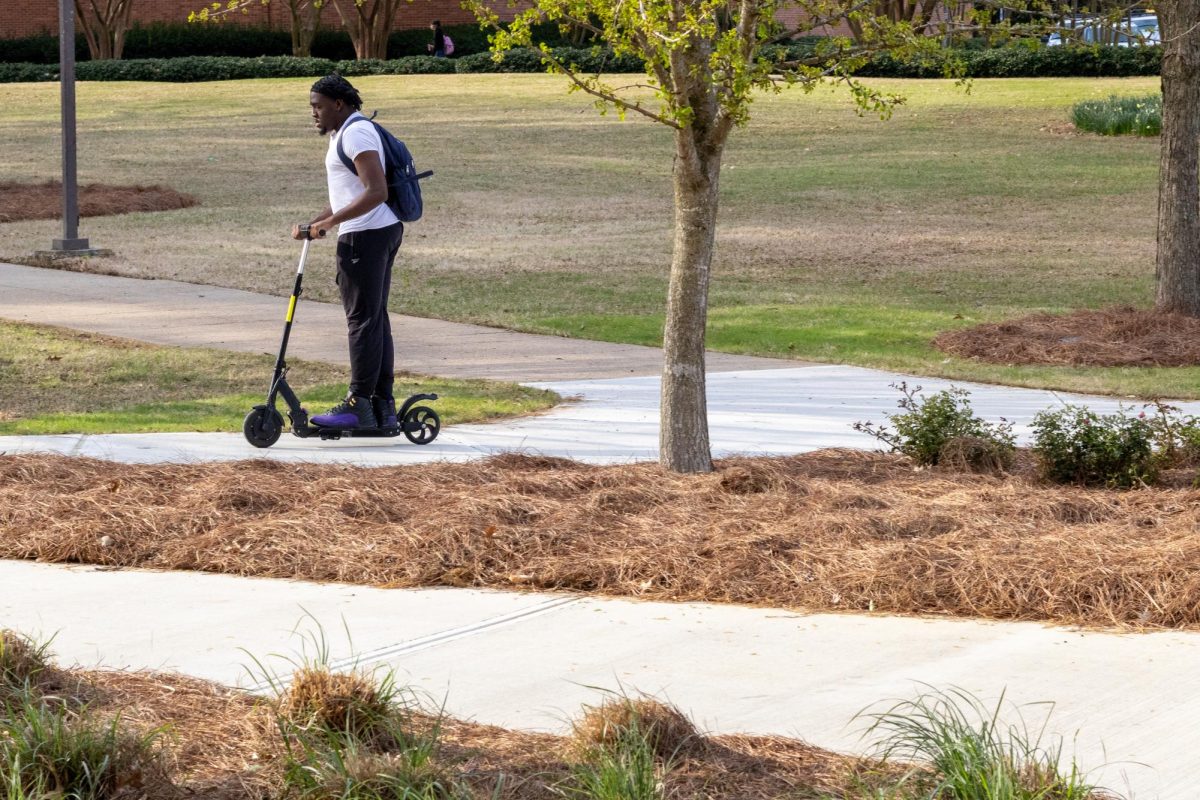
Thomas Bourgeois, Mississippi State’s dean of students, said many scooter thefts involve individuals taking the scooters for short rides rather than permanently stealing them.
“Scooter theft is also typically considered joyriding,” Bourgeois said. “People will often steal scooters just to drive them halfway across campus.”
Bourgeois works closely with the MSU Police Department to monitor campus safety and said the university has recently discussed the increase in scooter theft reports.
He said the growing popularity of electric scooters has likely contributed to the rise in theft incidents.
The issue of scooter thefts is not unique to Mississippi State, as multiple universities across the United States have seen similar increases in reports of missing scooters. Schools such as Florida International University, the University of Utah, the University of Washington, the University of North Carolina and even Harvard have all reported trends in scooter thefts on their respective campuses.
University officials recommend that students take precautions when using bikes and scooters on campus. In addition to following safety practices such as slowing down near pedestrians, students are encouraged to secure their bikes or scooters using locks and park them only at designated racks.