

In May, Mississippi State University’s Fostering LGBTQ+ Advocacy, Resources, and Environments (F.L.A.R.E.) joined as plaintiffs on a lawsuit filed by the American Civil Liberties Union Jackson office challenging parts of Mississippi House Bill 1193, the state’s new law restricting diversity, equity and inclusion efforts in public education.
The bill, signed into law by Gov. Tate Reeves on April 17, seeks to limit “divisive concepts” from being included in classes, programming and employment that use state funding at public schools in Mississippi.
The ACLU lawsuit, Jackson Federation of Teachers v. Lynn Fitch, argues that several sections of the bill are unconstitutionally vague and infringe on First Amendment rights. Because of that case, sections 3(b), 3(f), 3(g), and 3(i) of the bill were placed under injunction on Aug. 18, meaning they cannot be enforced until the case is concluded.
“It is unconstitutionally vague, fails to treat speech in a viewpoint-neutral manner, and carries with it serious risks of terrible consequences with respect to the chilling of expression and academic freedom,” the order, signed by U.S. District Court Judge Henry Wingate, reads.
F.L.A.R.E. advisor Austin Tello, who took over the role after the Holmes Cultural Diversity Center became the Holmes Center for Student Success in the spring, said that the board had questions about what becoming involved would mean, but ultimately wanted to fight to continue supporting the LGBTQ+ community on campus.
“This is exactly what we stand for, is advocating for the students that are here on our campus,” Tello said.
Tello said that the injunction gives him hope that the lawsuit will be successful, but he is being cautious. Tello is also the assistant director of residence education for MSU Housing and Residence Life.
“I think we have a chance, and I think that the injunction shows that there’s some legal grounds for what we’re arguing,” Tello said. “But I think that a lot of cases in our state and in our country lately have gone in ways I wasn’t expecting. So you never know.”

has not been able to hand out this year. (Ivy Rose Ball)
House Bill 1193 impacts student organizations
On April 17, Gov. Tate Reeves signed Mississippi House Bill 1193 into law. This law seeks to prohibit public schools and universities from taking certain actions and engaging in practices deemed discriminatory, aiming to ensure employment and programming are based solely on merit and qualifications and do not consider factors such as race and sex.
Although H.B. 1193 lists student organizations as an exception to the law so long as they do not use state funds, the law’s vagueness has left administrators to interpret its meaning. Under the Mississippi Institutions of Higher Learning’s interpretation, all MSU student organization funding, particularly the appropriations normally distributed through the Student Association, has been halted for the fall until more guidance is provided.
For organizations like F.L.A.R.E., that uncertainty has meant more than just red tape. According to F.L.A.R.E. President Ryan Langley, a junior majoring in computer science and minoring in linguistics, it has limited their ability to host events and support the LGBTQ+ community as they once did.
“Like, without these resources that we’ve had in the past… we’re able to scramble something together but unable to securely and, I guess, even efficiently, like have these events,” Langley, who is bisexual and genderqueer, said.
Tello said the bill’s vagueness and the lack of understanding of how it is meant to be implemented have been frustrating.
“It seems like people that don’t have anything to do with higher ed are actively policing higher ed,” Tello said. “And so then, when we get asked questions about why a decision was made or why policy changed university-wide, we don’t have answers. We can point to the law and say this is when things changed, but we don’t know the why of it, and we don’t know how long it’ll be until things are back to normal.”
ACLU attorney Ayanna Hill, who is involved in the case, talked about the importance of clarity in laws.
“If reasonable people wouldn’t know what a term means in a section, [they] don’t know how to not violate the law,” Hill said.
The build-up to H.B. 1193’s passing
In February, the U.S. Department of Education sent out a federal directive in the form of a “Dear Colleague” letter, ordering public universities to halt any programs that use race as a factor.
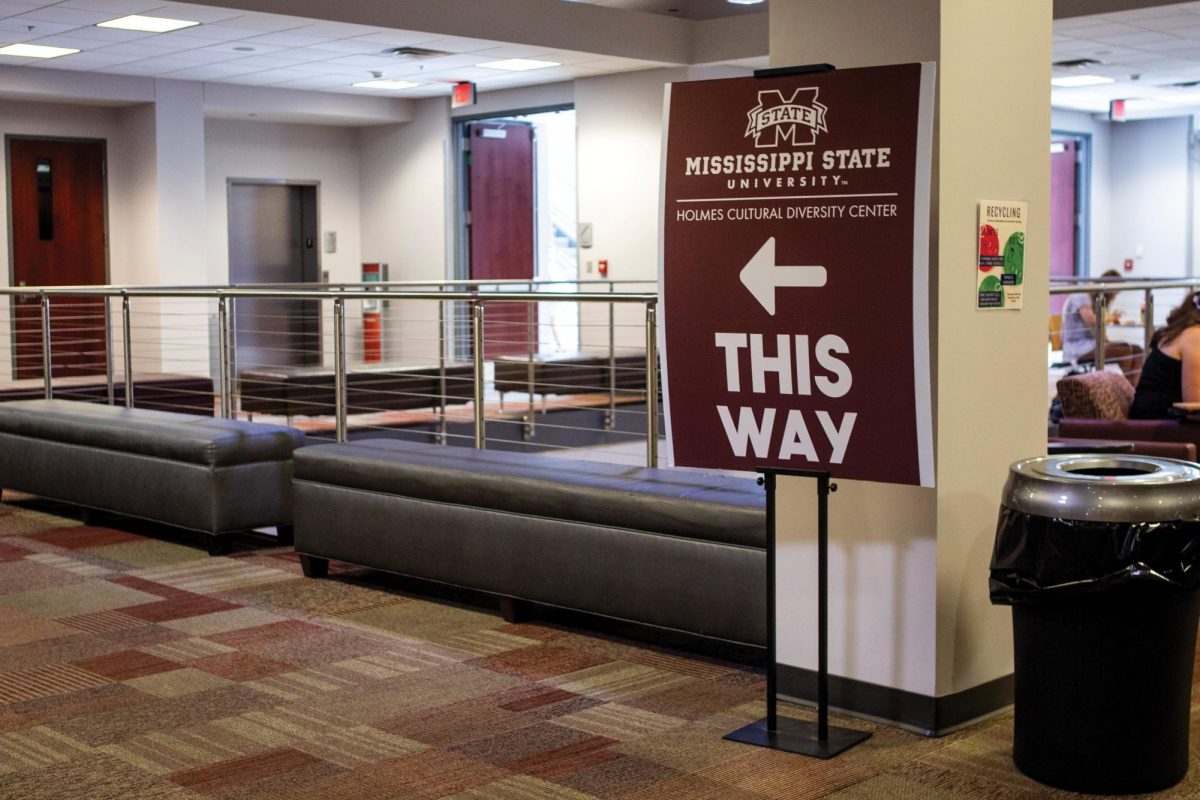
In an effort to protect the university’s federal funding, Mississippi State University administration quickly began making changes. One of the first of these was the transformation of the Holmes Cultural Diversity Center to the Holmes Center for Student Success, broadening the center’s programs to no longer focus on minority and marginalized communities and severing its sponsorship of student organizations serving those communities.
Among those student organizations were clubs like the Black Student Association, Latino Student Association, the International Student Advisory Board and F.L.A.R.E.

Holmes Center for Student Success last semester. (Ivy Rose Ball)
Langley said he felt helpless as he watched the HCDC, a space he had come to know as a joyful, safe space for minority groups to gather, become just another campus study space aimed at supporting student success.
“For me, it was just very, it was very, very upsetting,” Langley said. “…I’m not trying to be dramatic, but it was kind of like just seeing this community crumble around me. And like, as the HCDC became the HCSS, it felt so disgusting to me just kind of seeing it get ripped away.”
In the transition, F.L.A.R.E. lost the financial support and advisor previously provided by the Holmes Center. While LGBTQ+ programs were not directly targeted by the February federal directive, Langley said that he knew something would eventually come.
“Because, like once your brothers and sisters and like other communities, like other marginalized communities, are on the chopping block, you’re next, you know,” Langley said. “There’s no avoiding it. It’s going to happen. It’s almost always an inevitability.”
What’s next for F.L.A.R.E.
Langley said he fears what the outcome will be if the case is not successful. While F.L.A.R.E. has been able to fundraise some of the money it needs to continue programming, the support has been limited, and Langley claims that being able to receive some funding is essential to continue F.L.A.R.E.’s major events.
“I haven’t even given thought to the idea that it’s not going to happen, to be honest, because I think I’m afraid of what conclusions I’ll come to,” Langley said. “Yeah, like, it is integral to make sure that these communities aren’t—that their, these communities’ voices aren’t erased—in maintaining a society that is going to allow these communities to prosper in any way.”
Langley highlighted the importance of designated spaces for minorities to gather and build community. He said that it is not about segregating and that anyone is welcome, but that a space for minorities to be the majority is essential.
“It’s not trying to be discriminatory or be aggressive,” Langley said. “It’s just trying to find safety with people who understand you because of your shared experiences or similar experiences that just typically aren’t present in other demographics.”
Tello echoed this, saying that LGBTQ+ specific spaces are also important for ensuring the community can grow in a safe environment where students can support one another. He said that without them, LGBTQ+ students will seek connection elsewhere, such as on social media, which is not always safe.
“It’s much more common for folks in the LGBTQ plus community to be harmed or assaulted or things like that because of their identity… you just don’t know what you’re walking into sometimes,” Tello said. “At minimum, we provide a space that we know who these people are, we know that we’re safe.”
Langley spoke about the larger message this legislation sends.
“When you start to go after one community, you’re kind of setting a precedent…whether you’re intending to or not, you’re sending a message that you do not support diversity, you do not support people that are different from you,” Langley said.
According to Hill, the State of Mississippi has appealed the preliminary injunction to the Fifth Circuit Court of Appeals. The court will provide a briefing schedule, allowing the state and the plaintiffs to file their briefs. After that, there may be oral arguments, depending on what the state’s brief contains. The case will then proceed to a decision from the court.