
Student organizations at Mississippi State University are facing a year without funding after a state diversity, equity and inclusion law and its interpretation led to a halt in appropriations, leaving many groups struggling to host events, retain members and maintain a sense of community.
In April 2025, with the passing of Mississippi House Bill 1193, Mississippi universities were ordered to cut all DEI-focused university programs and activities. The following summer, interpretations of the law resulted in a halt in the distribution of appropriations to student organizations.
At Mississippi State University, these were distributed through the Student Association, with $47,000 being allocated across 80 student organizations in the 2025 spring semester. The money distributed came from the student activity fee, which is appropriated by student representatives in the Student Association to fund student organizations.
While HB 1193 was not originally intended to directly affect student organizations, its current form applies to any organization that uses state funds. However, the lack of clarity over whether the student activity fee is still considered state funds caused MSU and other universities in the state to halt student organization appropriations or risk losing state funding.
At the beginning of the fall semester, student organizations were notified via email from Student Affairs Vice President Regina Hyatt that they would not receive their usual appropriations for the semester. Later, it became clear that appropriations would not be allocated in the spring either.
Sections of the law are currently under injunction, awaiting a ruling in the Jackson Federation of Teachers v. Lynn Fitch court case. However, the injunction has changed little, as MSU and other universities in Mississippi have continued to act as if the law were still in place.
In the 2026 legislative session, which adjourned on April 5, Senate Bill 2525 was introduced to clarify that student activity fees are not considered state funds, but the bill died in committee.
How student organization appropriations normally work
Student organization funding at MSU comes through the $25 student activity fee paid by students. It is then allocated through the Student Association to student organizations.
Typically, the Student Association treasurer, who is elected annually by the student body, oversees the appropriations committee. For the 2025-2026 staff, this treasurer was Mary Walker Foster, a junior Business Administration major from Pascagoula, Mississippi, who was recently appointed as the Student Association chief of staff.
As treasurer, managing appropriations was supposed to be a major component of her job during the 2025-2026 year.
“It was very disappointing, not only for the student body, but that’s something that’s a huge part of being an SA treasurer, is doing appropriations and giving out, you know, these funds to student organizations,” Foster said. “And you know, it was really disappointing to hear that basically, the job that you had signed up for was not going to be able to be done.”
The impact
In the 2025 spring semester, over 80 student organizations received appropriations. In the 2025 fall semester, no student organizations received appropriations. Foster has seen the impact of this halt firsthand and shared how it has changed student organizations.
“I think it was a terribly negative impact,” Foster said. “I mean, it quite literally put all these student orgs just kind of at this halt of not being able to run their organizations and being able to get their word out and kind of express what they do.”
According to Foster, the Student Association tried to help organizations through other means, such as fundraising workshops. However, it became clear that these methods were not an adequate replacement for appropriations in getting funding to organization leaders who, at the end of the day, are just students.
She also shared how it hurt to see her fellow members of the MSU Student Association who are involved in other student organizations not receiving funding.
“It was just really disheartening to see friends not being able to get their funding to help student orgs,” Foster said.
Foster explained why having funding for organizations is so important.
She explained how organizations were able to host events at the YMCA Plaza and Drill Field with funding. They could provide food and giveaways to members and prospective members to help grow the organization. For example, if an organization could buy pizza for an event that attracted 30 people, those 30 attendees could then be encouraged to become members.
“It really was such a positive impact on our student orgs at the end of the day,” Foster said.
In addition, several other campus organization leaders shared their thoughts on the appropriation cuts.
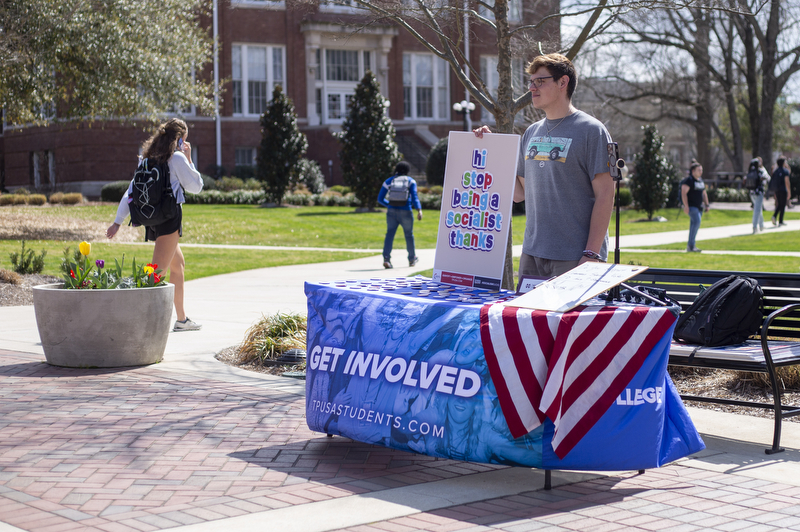
Turning Point USA president Samuel Gonzalez described the organization’s initial reaction to the lack of funding. Gonzalez said that the lack of university funding posed a challenge for TPUSA. The organization has a small number of members, so TPUSA has still been able to host events. However, their tentative plans were affected by the situation.
“My initial reaction was like, why?” Gonzalez said. “I mean, there’s so many different organizations that kind of need help, and we don’t have a steady supply of money or funds.”
Turning Point was not initially informed of the halt in appropriations and had to seek answers. Gonzalez was asked whether he believes other students understand what is happening with appropriations.
“Speaking with other people who are involved with organizations, they have told me that they don’t fully understand what’s going on, and I don’t fully understand either,” Gonzalez said.
Survey results
In late February, Reflector reporters sent a survey to the leadership of 85 of the 87 student organizations that received funding in Spring 2025.
The 22 responses received indicated that the majority of these student organizations are experiencing negative impacts from this halt in some way.
For example, CubeSat, which provides students the opportunity to develop technical skills by designing small satellites, has been impacted. The current president, Madelyn Berry, explained why appropriations were necessary for the organization.
“We have been unable to host the workshops to the same scale or at all,” Berry said. “We cannot purchase consumable equipment for skill development with our budget at this time.”
Another affected group is the Table-Top Gaming Club. President Spencer Cole explained why appropriations are important for a recreational organization.
“Our club depends on having a frequently updated and maintained inventory of board and card games available for use,” Cole said.
Maintaining that inventory ensures members have what they need to fully participate.
“[Appropriations] helped with the frequency that members would attend, growth potential, longevity and overall satisfaction of club members,” Cole said.
Without that support, the club has faced new challenges.
“[The appropriation halt] made it harder to do new, exciting things with the club, reducing potential for growth and making it a little harder to retain some members,” Cole said.
Clubs on campus are meant to foster connection and bring students with common interests together, but without appropriations, that goal becomes more difficult.
Not only were hobby and belief-based organizations affected, but the Shackouls Honors College Honors Council also lost financial support. President Luke Salisbury explained the impact.
“We used them to run events and service activities for the members of the Shackouls Honors College and all other interested parties,” Salisbury said.
Without funding, the number of events decreased significantly.
“We had to dramatically reduce the number of activities and service events we held to accommodate the budget cuts,” Salisbury said.
Salisbury said he has personally contributed money to maintain event quality.
“I have personally begun paying for certain aspects of events just to make them better experiences,” Salisbury said.
The organization has received some support from other sources, but not enough to fully replace appropriations.
“We have been greatly given some resources through the Honors College. If not for these funds, we would have had to shut down all activities and furlough the club,” Salisbury said.
These challenges also affect newer organizations seeking startup support. The Prehistoric Preservation Student Alliance, led by Jennifer Burt, is one such group.
“We are a new organization, and it took a long time for us to get a bank account,” Burt said. “We finally did, and we were only able to take advantage of appropriations once. We used the entire amount to purchase food for an off-campus end-of-year celebration that brought together students, faculty and professionals.”
Burt explained why those funds mattered.
“It made it fun, and cleared the expectation of having to find dinner that night,” Burt said.
Before appropriations were removed, the alliance had stronger attendance and consistency.
“We had once-a-month meetings in the fall, but attendance has fallen to where it is depressing for our executive members and makes a horrible impression to the professionals that come to speak,” Burt said.
Other organizations that provide students with a community to develop skills in their academic area are also struggling. One example is the National Society of Black Engineers, led by president Kyla Hunter.
“We used these funds for our annual fish fry, providing food and snacks at our General Body Meeting,” Hunter said. “Additionally, besides SA, we weren’t able to receive funds from our sponsors to pay for T-shirts, convention, merch and so much more.”
The loss of funding has left the organization unsure how to continue supporting its members.
“We were not able to provide for our members like we normally do,” Hunter said. “We weren’t able to do a fish fry, provide food at our meeting or even use funds from our normal sponsors. Less people are able to afford convention, our members still do not have T-shirts and we are having less and less merch to give out.”
While events with food or merchandise may seem unnecessary, they provide opportunities to build community within organizations. Hunter also shared how personal the impact has been.
“The personal impact is that I feel that even if our organization is growing, the way that we are able to support our members is not, and that’s what hurts the most,” Hunter said. “It feels that we are being punished for being an organization that supports minority students.”
The legislation affecting diversity, equity and inclusion initiatives has had a clear impact on organizations that support minority students, including those focused on developing future engineers.
AAPI
The Reflector interviewed Asian American and Pacific Islander Student Organization (AAPI) President Alice Phouasalith after receiving their survey response.
Phouasalith, a psychology major with a minor in child advocacy, said that the funding AAPI received from appropriations supported efforts to foster community on campus.
“We wanted to use those appropriations to host cultural events that highlight different holidays and bring people together through cultural exchange and unity,” Phouasalith said.
AAPI has previously hosted events such as a MasterChef-style competition and planned an Asian Heritage Month picnic, all aimed at fostering connection across cultures.
“Those kinds of events where people are trying to collaborate across different cultural clubs take a lot of money,” Phouasalith said.
She added that food plays a key role in bringing students together.
“A lot of the things that, like, bring college students together is food. So, a lot of ways that we celebrate, like our culture and having other people hear about it, is through food,” Phouasalith said.
Phouasalith said that while AAPI has been able to adapt to financial changes, the cut in financial support has changed how diverse communities feel welcome at MSU.
“It hasn’t, like, affected the money so much yet, but I feel like it’s affected the attitude and just having a welcoming environment, knowing that you’re being supported,” Phouasalith said.
While AAPI has had some success with fundraisers such as brownie sales and International Fiesta, these efforts are more difficult without institutional support.
“With the budget cuts, it’s been difficult to do those kinds of events and have different organizations participate.”
The issue remains unresolved, and many organizations continue to struggle without appropriations. University administration appears to be working toward a partial solution. On March 31, the Mississippi State Division of Student Affairs announced on Facebook the creation of the Registered Student Organization Support Fund, which allows individuals to donate through the foundation, with funds distributed to student organizations.